


Most of us did not choose our home desk. It is the corner that was free, the table that was already there, or the spare room that still has a bed in it. That is fine. A desk does not need to be large or expensive to work well. It needs to be lit properly, clear of things you do not use and comfortable enough that you stop noticing it.
Over the last year we have changed the desks in the Denver studio a little at a time. None of the changes cost much, and most of them took an afternoon. These are the five that made the biggest difference.
- Add a lamp to the side, and turn the ceiling light off
- Put the screen at arm’s length, with the top at eye level
- Screw one cable tray under the desk
- Give every small thing a single place to live
- Clear the surface at the end of each day
Start with the light
If you change one thing, change the light. Ceiling lights are placed to light a room, not a desk. They sit behind you, throw your shadow across the page and bounce off the screen. A small lamp to the side of the desk, on the opposite side to your writing hand, puts the light where you need it and nowhere else.
Choose a warm bulb, around 2700 K, and a shade that hides the bulb from your eyes. The Arc Desk Lamp was designed for exactly this, but any lamp with a tilting shade will do. We wrote more about this in Light for late evenings.
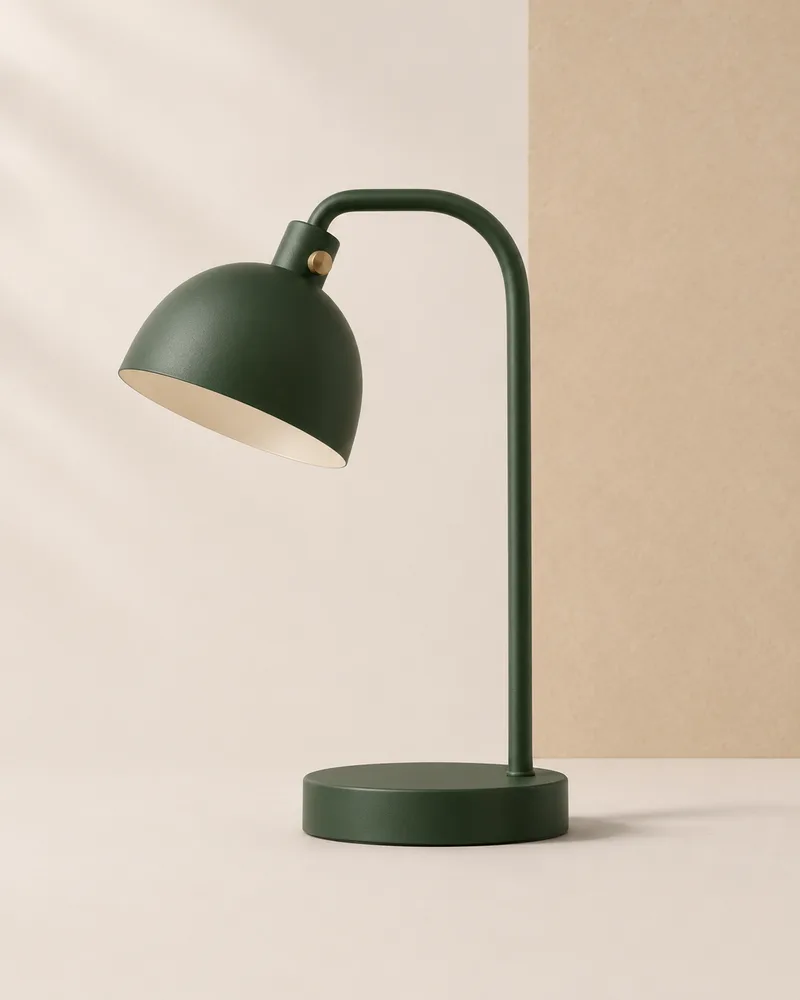
In the day, face the desk so that the window is to the side rather than behind the screen or behind you. Daylight from the side is the best light you can get, and it costs nothing.
In the evening, keep a second, softer light on somewhere else in the room, so the lamp is not the only bright thing you can see. Too much contrast between a bright desk and a dark room tires your eyes almost as much as too little light.
Get the screen and chair right
The second change is about your neck. A laptop on a table puts the screen too low and too close, and after a few hours you feel it in your shoulders. Raise the screen so the top edge is roughly at eye level and about an arm’s length away. A stack of books works. So does a simple wooden stand.
If you use a laptop all day, a separate keyboard and mouse let you raise the screen without raising your hands. Your elbows should sit at about the height of the desk, with your shoulders relaxed. If the chair is too low, a firm cushion is cheaper than a new chair.
The one tray that ends cable chaos
Cables are the reason most desks look untidy. The fix is not a box on the desk or a set of clips. It is a plain steel cable tray screwed to the underside of the desktop, near the back edge. We do not sell one, and you do not need a special one: a basic tray from any hardware shop costs less than a lunch.
Put the power strip in the tray, plug everything into it and run a single cable down to the wall. Chargers, adapters and spare lengths of cable all live in the tray, out of sight but within reach. It takes about half an hour, including finding the drill.
A place for everything, and an empty surface
Small things drift. Pens end up in three mugs, the notebook migrates to the kitchen and the charger for your headphones is never where you left it. Give each of them one place and put it back there. We use the oak tray from the Studio Desk Set for the few things that stay on the desk: a pen, a pencil, a notebook and whatever we are working on that day.
-

Shop the story
$64Ships in 2–3 business days
View: Studio Desk Set
Everything else goes into a drawer or a box on a shelf. The rule we follow in the studio is simple: if you have not touched it this week, it does not belong on the desk.
The notebook deserves a mention of its own. A paper list of the three things you want to finish today, open next to the keyboard, does more for focus than any app we have tried, mostly because it cannot send you notifications.
The last change is a habit rather than a purchase. At the end of the day, take five minutes to clear the surface. Close the notebook, put the pens in the tray, take the cup to the kitchen and switch off the lamp. It sounds small, but it draws a line under the working day, which matters more when your desk is in your home. It also means the next morning starts with an empty desk rather than yesterday’s leftovers.
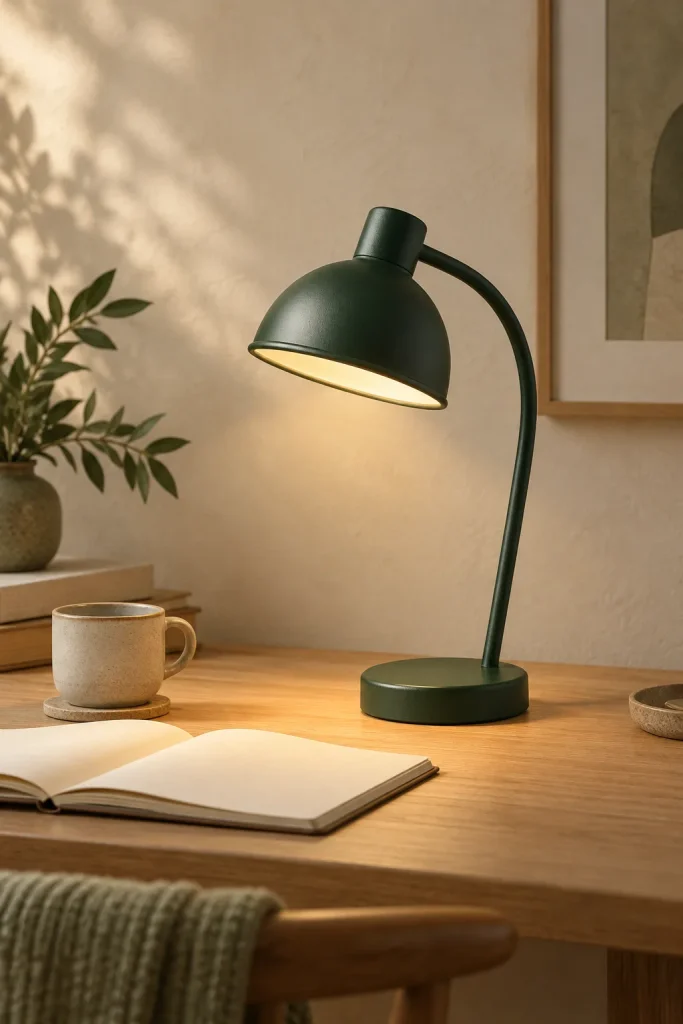
None of this needs to happen at once. Start with the light, give it a week, and see how your eyes feel by the evening. Then move on to the next thing.
Quick answers
How bright should a desk lamp be?
Brighter is not better. For reading and writing in the evening, around 300 to 450 lumens is plenty. A lamp that dims in steps lets you start brighter and turn it down as the room gets darker.
Do I need a standing desk?
Not to start with. Moving matters more than standing: get up every half hour, even if only to refill your cup. If you find you want to stand, try a sturdy box on the desk for a week before you buy anything.



One response
Author
The tray idea worked. Everything that used to live in a heap by the monitor now has one place.
Comments are closed.